
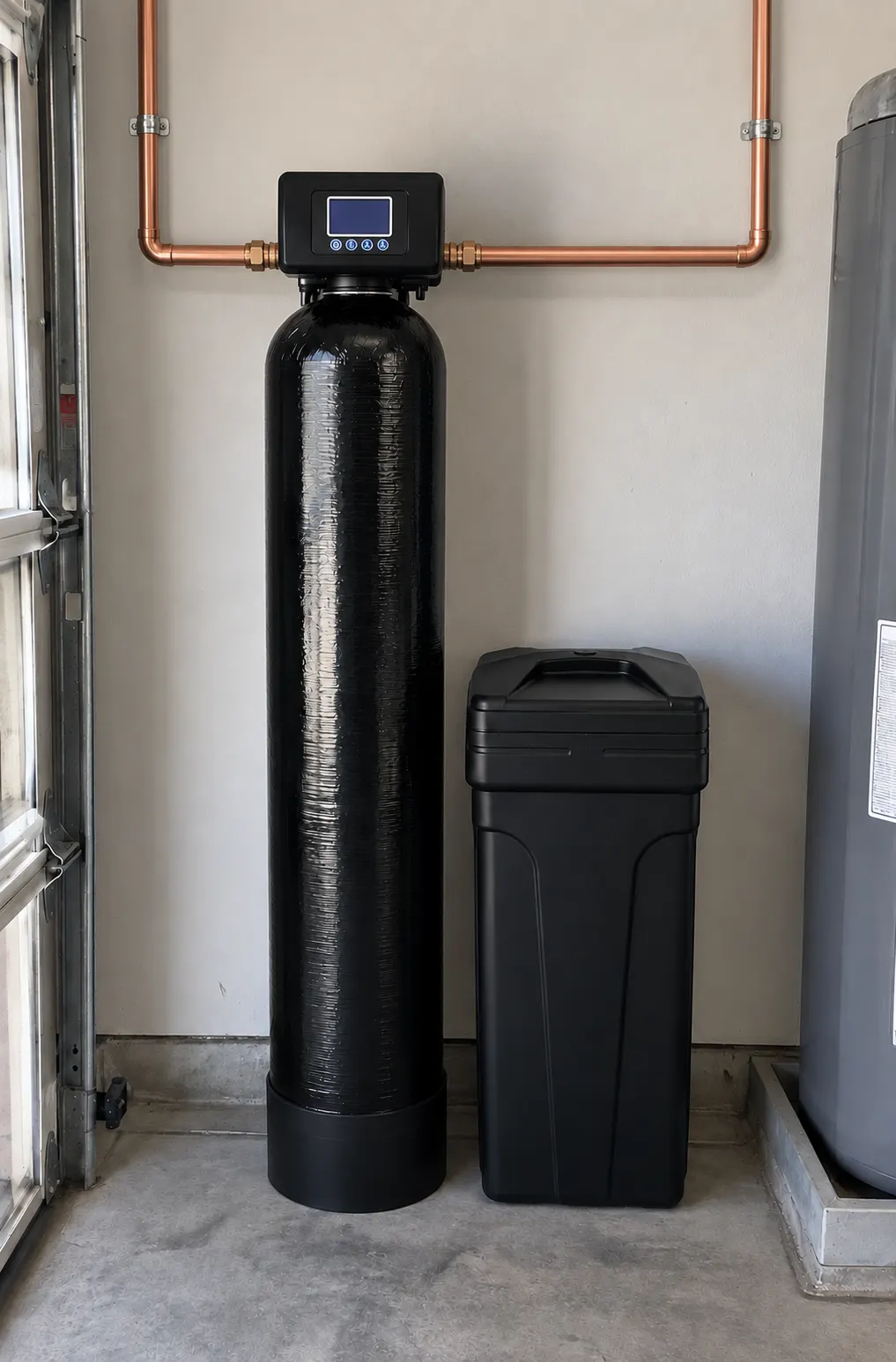
Water Softener Installation Explained Simply
Water softener installation means testing your water, sizing a softener to your hardness and household, and plumbing it in at the main line with a bypass valve. Salt Lake City's canyon water measures about 8 to 12 grains per gallon, and some wells far more. We install single-tank combo, dual-tank and salt-free systems.
Hard water gets into everything. It leaves scale in your water heater and dishwasher, many people say it leaves their skin feeling dry, and it makes soap harder to rinse off. Cleaning won't make it go away, because tomorrow's water brings more minerals. We can test your water, size a softener for your home and get it installed, so every tap runs soft.
Soft water isn't a luxury in this part of Utah. It's the difference between a water heater that runs clean for years and one that fills with scale. It's the difference between glass shower doors that wipe clean and ones that stay cloudy no matter what you spray on them.
Signs You Need Water Softener Installation
The easiest sign to spot is white, chalky buildup on faucets, showerheads and the inside of your kettle. That's calcium and magnesium left behind when water dries. You'll also see spots on dishes and glasses, soap scum that comes back fast, and laundry that feels stiff.
The costly sign is the one you can't see. Scale builds up inside your water heater, dishwasher, washing machine and pipes. The U.S. Geological Survey notes that this scale can shorten the life of equipment, raise the cost of heating water and clog pipes.
Waiting only lets more scale build up. If you already have an old softener, it may make more sense to replace it than repair it. That's often true if the tank is cracked, the resin is worn out, or the control valve is too old to get parts for. If the system is otherwise sound, our Water Softener Repair service may be all you need.
You might also notice you use more soap and shampoo than you should, because hard water doesn't lather well. Towels come out of the dryer rough. Your skin feels tight after a shower. None of these are big on their own, but together they're a daily reminder that the water in your house is working against you.
Our Water Softener Installation Options
Every install starts with a water test and a look at your plumbing. We check your hardness, whether you're on city water or a well, how many people live in the house, and where the system will go. Then we recommend a size and a type that fits.
For most city-water homes, a good place to start is the Water Softener + Carbon Filter Combo. It puts softening resin and coconut shell carbon in a single tank, so one system cuts hardness and chlorine taste together. It's a smart pick when you want soft water and better-tasting water without a second tank.
Bigger households, or homes that use a lot of water, do better with a Dual-Tank Water Softener. One tank holds a larger bed of softening resin and the other holds carbon. Splitting the two jobs gives you more capacity and better performance than a single mixed tank.
If you want to protect your pipes and appliances from scale without adding salt, a Salt-Free Water Conditioner is the option. It doesn't remove hardness minerals, so your water won't feel slick like softened water. It does stop the minerals from sticking as scale, with no brine tank, no drain line and no power.
Every softener we install includes a bypass valve, so you can shut the system off for service and still have water in the house.
We'll also talk through salt. A salt-based softener needs its brine tank topped up from time to time, and the systems we install hold up to 150 pounds of salt at once. We set the valve so it only regenerates when it needs to, which keeps salt and water use down. If carrying salt bags is a deal-breaker, that's when we look at a conditioner instead.
Most homes also benefit from a Sediment Pre-Filter ahead of the softener, especially on older plumbing or wells. It catches sand and rust before they reach the resin, and it helps the whole system last longer.
Water Softener Installation for Salt Lake City Homes
Water across the Wasatch Front is hard. The Jordan Valley Water Conservancy District, which serves much of the south valley, lists its water at about 170 mg/L, or 10 grains per gallon. That's in the hard range. In Salt Lake City, Millcreek and Holladay, city water comes from a blend of mountain streams and wells, and hardness can change with the source. North in Bountiful and south in Utah County, the mix is different again.
That's why we don't guess. We test your water before we size your system, and we set the regeneration schedule for your actual hardness. Softeners that are set too light leave hard water behind. Ones that are set too heavy waste salt and water. Homes on private wells may also need Well Water Treatment ahead of the softener to deal with iron.
What to Expect
When you call, we get back to you in about 10 minutes on average. We'll ask a few questions about your water and your home, then set up a time to test and look at the install spot. You'll get a price for the equipment and the installation before any work starts. On install day, we plumb in the softener and bypass, connect the drain and brine tank, program the valve for your water, and show you how it works.
If you already have an old softener, we'll disconnect it and plumb the new one into the same loop when we can, which keeps the job simpler. If there's no loop yet, we'll show you where the new lines will run before we cut anything.
Why Choose Us for Water Softener Installation
We respond in about 10 minutes on average. We're an authorized dealer for the softeners we install, so the team that sells your system is the team that installs and services it. We're Utah locals with offices in Salt Lake City, Draper and Springville, close to every city from Bountiful to Spanish Fork. You get honest advice, a clear price up front, and soft water at every tap.
Looking for something else? See all of our water softener and water treatment services in Salt Lake City.